Compare pictured kit layouts
.webp&w=3840&q=75)
.webp&w=3840&q=75)
.webp&w=3840&q=75)
.webp&w=3840&q=75)
Maximum label versus nominal pack voltage
| Common label | Typical series-cell clue | Approximate nominal range | Buyer action |
|---|---|---|---|
| 12V max | 3 cells × 4.2V fully charged | 10.8–11.1V | Confirm whether 12V means maximum voltage. |
| 16.8V max | 4 cells × 4.2V fully charged | 14.4–14.8V | Verify the battery label, cell count and charger. |
| 21V max | 5 cells × 4.2V fully charged | 18–18.5V | Do not compare performance from the label alone. |
Official labeling examples: Bosch Professional explains 10.8V nominal versus 12V maximum; DEWALT states that 20V MAX has an 18V nominal voltage.
Buyer discussion pattern: conversations among tool users commonly weigh compact size, usable power, ergonomics and battery-platform compatibility. These experiences help form sample questions, but they do not replace model-specific test data.
What buyers should know
A 12V, 16.8V or 21V label does not by itself rank drill performance. First identify whether the number is maximum or nominal battery voltage and confirm the series-cell count. Then compare model-specific torque, speed, chuck, motor, battery capacity, charger, runtime, heat, kit contents, packaging and applicable compliance documents under the same test conditions.
1. Why drill voltage labels confuse buyers
Buyer discussions repeatedly return to the same questions: Is 12V enough? Is 18V different from 20V? Does a larger number guarantee more torque? The answers depend on labeling convention, tool design and intended work.
Bosch explains that its former 10.8V class and 12V class refer to the same compatible platform: 10.8V describes average battery voltage while 12V describes maximum voltage. DEWALT similarly states that 20V MAX has an 18V nominal voltage. These official examples show why buyers must ask how a supplier defines the printed voltage.
2. Read 12V, 16.8V and 21V as battery-system clues
A conventional lithium-ion cell reaches about 4.2V when fully charged. Three cells in series can therefore be marketed around 12V max, four around 16.8V max and five around 21V max. Nominal voltage depends on the cell specification, commonly around 3.6V or 3.7V per cell.
This calculation is a screening tool, not proof of a pack’s construction or performance. Ask for the battery label, series and parallel arrangement, cell model, stated capacity, watt-hours where available and compatible charger. Do not infer these details from housing shape or a marketplace title.
3. Voltage alone does not tell you drilling performance
A higher-voltage platform can support greater power, but the label alone does not establish usable torque, drilling capacity or durability. Motor type, winding, controller, gearbox, chuck, battery current capability and thermal design all affect the result.
Compare samples using the same material, bit, hole diameter, depth, gear and battery state. Record speed, task completion, heat, protection behavior and runtime. Treat torque and capacity claims as model-specific only when the supplier provides the test method or datasheet.
4. Match the voltage class to the retail customer
Compact 12V-class tools can suit furniture assembly, light fastening, maintenance and buyers who value low weight and access in tight spaces. A 16.8V-class offer can occupy an intermediate retail position, but it still requires model-specific evidence.
A 21V-max-style five-cell platform may suit buyers seeking a larger cordless kit or more demanding positioning. Do not promise professional performance from the voltage label alone. Define the work, price band, warranty expectation and replacement-battery plan before selecting the platform.
5. Compare the complete VONVIX kit, not an isolated drill
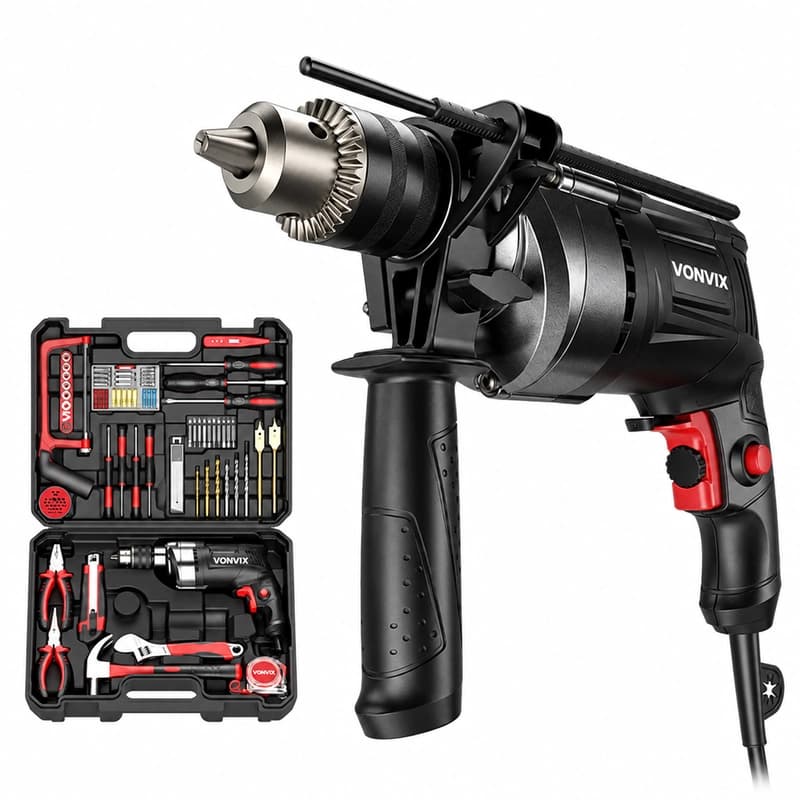
VONVIX currently shows five orderable photo references: yellow cordless case kit REF 01-3, yellow impact accessory kit REF 01-2, orange impact dual-battery kit REF 02-1, corded tool case REF 03 and corded accessory kit REF 03-1. Each image links to its own product reference.
The orange cordless references visibly carry 21V labeling, including a pictured one-battery 2.0Ah offer and a dual-battery 4.0Ah offer. These are pictured labels, not independent capacity verification. The final quotation must state the drill model, battery count and capacity, charger, case and every accessory quantity.
The corded references are not part of the 12V/16.8V/21V battery comparison. Their quotation must instead confirm mains voltage, frequency, plug, rated input and included tools.
6. Lock packaging data after the kit is fixed
The VONVIX photographs show fitted cases, batteries, chargers, bits, sockets and other accessory layouts. They help buyers choose a retail presentation, but a photograph is not a contractual packing list.
Final case layout, units per carton, color-box or sleeve, master-carton dimensions, net weight and gross weight vary with battery count and accessories. These figures are not yet published as one universal drill-kit carton. Request a model-specific packing specification and verify it against the approved packed sample before using the data for freight calculations.
7. Request certificates by model and battery pack
Available document previews can include CE, RoHS and battery-related files such as UN38.3 or MSDS where applicable. Their relevance depends on the selected drill, charger, plug, battery cell or pack and destination market.
Review the VONVIX Certifications & Compliance page, then request the full files matching the quotation. Check the applicant or certificate holder, product or battery model, standard, report number, laboratory, issue date and validity. A document for one battery pack must not automatically be applied to another configuration.
8. Send an order-ready voltage and kit inquiry
Send the photo reference, intended work, target market, quantity and preferred voltage class. Ask the supplier to state maximum and nominal voltage, battery construction and capacity, charger input and plug, motor type, speed, torque evidence, chuck, kit contents, packing data, MOQ and sample schedule.
For an honest comparison, keep the application and accessory list constant. Approve the physical sample, battery label, charger, packing list, artwork and compliance document set together before bulk production.
Procurement FAQ
Is a 21V cordless drill automatically stronger than a 16.8V drill?
No. The label may describe maximum battery voltage and does not by itself verify torque, speed, runtime or drilling capacity. Compare model-specific design and repeatable sample tests.
Are 18V and 20V MAX always different systems?
Not necessarily. Some manufacturers use nominal and maximum labels for the same voltage class. Confirm the battery platform and manufacturer specification instead of comparing the printed numbers alone.
What does a wholesale buyer need on the battery label?
Confirm battery model, voltage definition, capacity, watt-hours where available, cell or pack identification, charger compatibility and the exact product models covered.
Does VONVIX publish one carton size for every drill kit?
No. Battery count, case and accessory selection change packed dimensions and weight. Request the final model-specific packing specification before freight calculation.
Which documents should I request for a cordless drill kit?
Request the product, charger and battery documents applicable to the selected model and destination market. These may include CE, RoHS, UN38.3 and MSDS-related files where applicable.
This guide is reviewed by Niki from the VONVIX sourcing team and reflects the product selection, sample approval and quality-control questions commonly discussed with international buyers.
About VONVIX